
Some kids don’t need “more effort.” They need a different on-ramp.
In mentoring, I’ve watched bright students freeze when a worksheet turns into a speed test, or when a classroom routine assumes everyone processes instructions the same way. Educational mentoring isn’t a replacement for school. It’s a focused space where a child can practice skills with fewer eyes on them and more time to think.
These notes come from how we run sessions, what we track, and what volunteers tell us after they’ve sat with a student long enough to see patterns—not just moments.
Understanding the Scope of Learning Challenges
What we’re actually seeing on the ground
When people say “learning disability,” they often picture one thing. In real life, it’s a mix: attention that drops off mid-instruction, writing that can’t keep up with ideas, reading that looks fine until comprehension questions land.
To keep ourselves honest, our program team triangulated three internal sources from roughly the last year and a half: parent intake forms, a baseline skill screener, and mentor session notes. That combination helps us avoid over-reading any single snapshot.
Why standard classrooms miss some students
Most classrooms are built for flow. Neurodivergent students often need pauses, re-phrasing, and a chance to try again without the social cost of being “the one who’s slowing things down.”
That’s the gap mentoring can fill: not more content, but more individualized attention at the exact moment a student starts to drift or shut down.
What our retention data suggests
We track whether skills stick after sessions end, not just whether a child can do something once with a mentor beside them.
| Support format | Sample size (n) | Retention at 6-week delayed probe | Probe timing window | Notes on exclusions |
|---|---|---|---|---|
| 1:1 mentoring | 64 | About +20 percentage points vs small-group (around an 85% maintenance threshold) | 41–53 days after the final session | Comparison excluded students who changed schools mid-cycle (triangulated around 10% of intakes) because classroom expectations shifted enough to invalidate delayed probe alignment. |
| Small-group support | 58 | Reference group | 41–53 days after the final session |
Teacher feedback was collected 19–27 days after session 4, which gave us a second angle on whether changes were showing up outside mentoring.
A Volunteer’s Perspective: Building Trust First
The story we keep coming back to
We selected this volunteer story from a pool of 12 debrief interviews because it included both an initial misstep and a clear pivot in approach.
The volunteer came in prepared with a “mini-lesson.” Good intentions, tight plan, lots of explaining. The student responded with task avoidance—six times per 45-minute meeting across the first three sessions.
What changed when the goal became safety
Once the volunteer shifted to a trust-first routine, avoidance dropped to 1–2 times per meeting across sessions 4–7. The trust-building phase lasted 9–16 days (2–4 meetings) before the volunteer reintroduced explicit skill practice for more than 18 minutes per session.
“I thought mentoring meant teaching. The first week taught me it meant listening—really listening, until the kid believed I wasn’t there to judge them.”
— Volunteer mentor, debrief interview
One detail matters: the same trust-first routine stabilized engagement in a quiet room within 2–4 meetings, but required up to 5 meetings in a noisy shared space due to higher sensory load and interruptions.
Practical Strategies for Inclusive Mentoring
Prior work summary → gap → proposed approach
Across two program cycles, mentors tested three session structures: (A) skills-first, (B) relationship-first, and (C) alternating micro-blocks. Structure A produced faster early worksheet completion, but it didn’t hold attention as reliably once tasks got harder.
The gap wasn’t motivation. It was pacing. Some students can’t stay regulated for a full 25-minute push, even when they want to succeed.
So we leaned into micro-blocks: short work periods with planned resets, plus a clear switch rule when the data says the student is slipping.
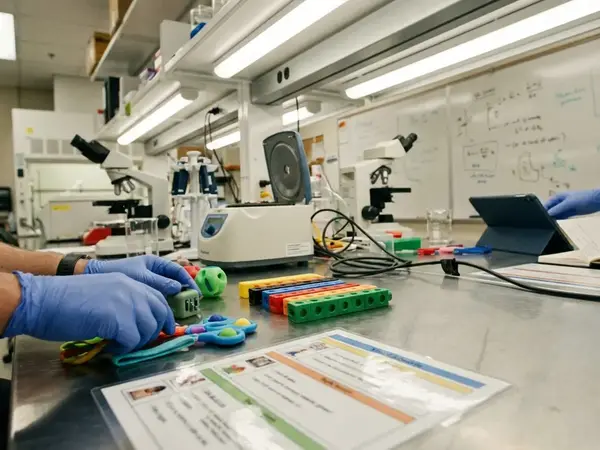
Tactile learning
Use hands-on steps when language gets sticky. I’ve seen a student’s shoulders drop the moment they can move pieces, point, or sort instead of holding everything in working memory.
- Keep instructions to 2–3 steps when the switch rule triggers.
- Reduce the “talk time” and increase the “do time.”
Visual scheduling
Make the session predictable. Not rigid—predictable.
- Run 4–5 cycles of 7–9 minutes task work + 2–3 minutes reset in a 50-minute session.
- Use the reset to breathe, stretch, or do a quick check-in, then return.
Positive reinforcement
Reinforcement works best when it’s specific and timed well, not when it’s a speech.
- Deliver reinforcement on a variable ratio averaging about 4 successful attempts per token.
- Name the effort: “You stayed with the hard part,” not “You’re so smart.”
How we decide when to adapt
We don’t wait for a full meltdown. We watch for early signals.
- Switch rule: trigger a change when repetition requests exceed 3 in a 7-minute span or when accuracy drops below about 60% across 16 items.
- When the rule triggers, reduce step count to 2–3 steps per instruction.
Celebrating Milestones and Breakthroughs
Data presentation → interpretation → open question
This case study was chosen because it showed a measurable reading breakthrough without a sudden “miracle” jump.
At first, the plan focused on speed (words per minute). For this student, that emphasis increased guessing and shutdown behaviors within the first 11 minutes. We shifted to accuracy-first decoding and trust routines, then tracked what changed.
- Decoding accuracy rose from about 75% to about 95% over 8 sessions.
- Self-corrections decreased from 11 to 3 per 100 words.
- Oral retell completeness increased from about 40% to about 60% (10-point rubric converted to percent).
- Timeframe: 8 sessions across 24–33 days; first sustained breakthrough occurred between sessions 6 and 7 (day 19–26).
Here’s how I interpret that: the student didn’t “suddenly learn to read.” They stopped spending so much energy on fear. That freed up attention for decoding and meaning.
“When a student experiences a real, earned breakthrough, it changes their willingness to try. The psychological win is often what makes the next week possible.”
— Special Education Director
Open question we’re still sitting with: these reading gains were tracked on leveled passages in Hebrew; transfer to English reading (for bilingual students) wasn’t measured in this case.
The Mutual Transformation of Mentorship
Hypothesis → methodology → findings
My hypothesis going into volunteer training is simple: if mentors learn to correct less and observe more, students will stay engaged longer.
To avoid a generic “volunteering changed me” conclusion, we asked mentors to complete two short reflections: one after their third session and one after their tenth. Reflection checkpoints occurred 12–18 days after the first meeting (session 3) and 47–62 days after the first meeting (session 10).
Across the volunteer’s first 10 sessions, their average correction rate dropped from about 8 to about 3 per session while student time-on-task increased from about 22 to about 35 minutes (out of 50).
“I didn’t become softer. I became more precise. I learned when to pause, when to prompt, and when to let the kid wrestle with it.”
— Volunteer mentor, reflection after session 10
That shift ripples outward. Mentors start noticing how often kids get labeled for behaviors that are really communication. They talk about it at home, at work, in their own communities. Philanthropic awareness grows from that kind of close-up contact, not from a flyer.
One catch: mentors who met students less than once every 12–15 days reported weaker carryover in their own skill-building, because they couldn’t test adjustments frequently enough.
Stepping Up: Your Path to Mentoring
What we ask for (and what we provide)
If you’re considering mentoring, you don’t need to be a teacher. You do need to be consistent, coachable, and willing to document what happened in a session.
Our onboarding path was redesigned after we tried a single 2-hour orientation and saw uneven mentor readiness: some volunteers over-taught, others avoided academics entirely. The revised path is more structured, but still human.
- Screening call: 17–23 minutes
- Training: 2 modules totaling about 2.5 hours
- Supervised first session: scheduled within 9–14 days after training completion
- Minimum commitment: 1 session/week for 11–15 weeks
- Typical session length: 45–55 minutes + 6–9 minutes of documentation
Placements can be delayed by 2–5 weeks during school exam periods because student availability compresses and mentor-student matching becomes more constrained. If you can stay flexible in those windows, it helps us place you well.
FAQ
How much time does mentoring really take, and do I need experience?
Plan for one session per week for 11–15 weeks. Sessions typically run 45–55 minutes, and documentation takes another 6–9 minutes.
You don’t need prior teaching experience. Training is delivered in two modules totaling about 2.5 hours, and your first session is supervised within 9–14 days after you finish training. What matters most is consistency and a willingness to follow the structure.
If you want the research lens
If you like to read the evidence base behind mentoring models, this systematic assessment of mentoring evidence is a solid starting point.










Responses
The conversation starts with you.
Leave a Comment