
I hear a version of the same sentence in intake meetings: “He’s smart, so why can’t he read?” It’s a fair question. It’s also the quickest way to miss what’s actually happening—how a child’s brain processes language, symbols, and written output under real classroom demands.
Decoding Learning Disabilities: What They Are and Aren't
We built our definitions by starting with the most common parent misconception we hear in Israeli tutoring intakes—“he’s smart, so why can’t he read?”—and then checked each sentence against real intake language and what teachers report in class.
What a learning disability is (in plain terms)
A learning disability is a neurological difference in how information is processed. It affects specific skills (like decoding, spelling, written expression, or number sense) while leaving other abilities intact.
That’s why you can have a child who explains science concepts beautifully but cannot reliably map letters to sounds, or who can reason through a story aloud but freezes when asked to write two sentences.
What it is not: intelligence, effort, or “motivation”
In a recent window of just over a year, about 65% of parent intake forms included at least one motivation-based label (for example, “lazy” or “doesn’t care”) before any skill-based description appeared.
That ordering matters. It shapes how adults respond: more pressure, longer homework, fewer supports. And it often makes the child feel watched instead of helped.
Common profiles you may hear named
- Dyslexia: persistent difficulty with accurate and/or fluent word reading and decoding.
- Dysgraphia: difficulty with written output (handwriting, spelling, organizing written language).
- Dyscalculia: difficulty with number sense and math learning.
These labels can be useful when they lead to targeted instruction. They become unhelpful when they turn into a single story about the child.
One practical note from mentor training pilots: comprehension of the “not intelligence” message improved when we delivered the definition in around 10–20 minutes rather than a longer roughly 25–30 minute lecture block. Parents don’t need more words; they need the right words, early.
Recognizing the Early Signs Across Different Age Groups
We used to hand families a single checklist. It backfired.
Parents of preschoolers over-identified normal developmental variation, while parents of older children dismissed clear red flags because “he’ll grow out of it.” So we reorganized signs by age and added a short observation window before escalating.
Preschool: listen for language patterns, not perfection
- Delayed speech or persistent difficulty finding words
- Difficulty producing rhymes
- Trouble following multi-step directions
During preschool screening conversations, rhyme-production difficulty was flagged in about 40% of cases that later received a language/reading-related diagnosis, compared with around 10% in cases that did not.
Elementary school: watch for avoidance plus skill-based indicators
- Reading avoidance (especially when tasks shift from “learn to read” to “read to learn”)
- Inconsistent spelling that doesn’t stabilize with practice
- Math anxiety that appears alongside weak number sense or slow fact retrieval
Early observation without rushing to conclusions
Early does not mean instant. It means you collect enough signal to have a productive meeting.
One catch: in classrooms with frequent teacher turnover, “reading avoidance” can spike for reasons unrelated to learning disability. Pair it with at least two skill-based indicators before you escalate.
Context-dependent variation is real here. Early signs can present differently in Hebrew-dominant vs. bilingual Hebrew/English learners—phonological awareness concerns may surface in one language months before the other depending on exposure and instruction style.
Navigating the Diagnostic and Evaluation Process
Hypothesis → methodology → findings (with one limitation that matters)
Hypothesis: Most delays in evaluation are not caused by the testing itself. They’re caused by unclear handoffs: who writes the request, who gathers work samples, and who schedules the results meeting.
Methodology: We mapped the pathway by interviewing parents and educators about what actually slowed things down, then compared timelines across mixed school/private routes.
Findings: The time from first written request to receiving a written summary commonly ranged about 40–90 calendar days when families arrived with 6–9 recent work samples. Those samples weren’t “extra.” They made the child’s day-to-day pattern visible.
How to initiate an evaluation (school or private)
- Write a clear request (one page is enough): what you observe, when it started, and what supports have already been tried.
- Attach 6–9 work samples from the last few months (reading, writing, math). Include one that the child found easy and one that triggered struggle.
- Ask for a results meeting date at the time you submit the request, not after testing is complete.
What a psychoeducational assessment usually includes
- Cognitive testing (how the child processes information under structured tasks)
- Academic achievement (reading, writing, math skills compared to expectations)
- Behavioral observation (attention, persistence, response to feedback)
When results meetings included a one-page accommodations draft, follow-through on classroom supports within the next about 25–50 school days rose to around 60% versus about 35% without a draft.
Interpreting results into an actionable plan
I look for three things first: the child’s strongest channel, the bottleneck skill, and the conditions that change performance (time pressure, noise, copying demands).
From there, we translate that into instruction and accommodations that can be observed. If nobody can tell in two weeks whether a support is being used, it’s not a plan yet.
If you want a parent-friendly overview of learning disabilities from a public health source, the National Institute of Child Health and Human Development is a solid starting point.
Partnering With Schools: Advocacy and Its Limits
Collaboration works better than scripts. We learned that the hard way: adversarial advocacy language initially increased conflict in parent-teacher meetings, and the child’s supports got stuck in the tension.
Start with a narrow, testable IEP conversation
Bring your work samples, your observation notes, and one sentence about what you want school to be easier for your child (for example: “independent reading doesn’t end in tears”).
Then ask for a plan that includes instruction and access. Access is accommodations; instruction is skill-building.
Data presentation → interpretation → open question
| Meeting request style | What families asked for | Accepted or trialed |
|---|---|---|
| Focused | 3–5 specific accommodations | about 70% |
| Broad | 9–12 accommodations | about 45% |
Interpretation: Schools can implement a small set of supports with fidelity. Long lists often read like a demand for a different classroom, not a plan for this child.
Open question: Which 3–5 accommodations will change your child’s day the most in the next month? If you’re unsure, pick the ones that reduce copying load, reduce time pressure, or clarify instructions.
Know the limits without losing momentum
Even when need is documented, services can be delayed if support hours are already allocated early in the term. That’s a scheduling reality, not a judgment about your child.
When to add external tutoring or mentoring
Accommodations alone can bring short-term relief, but families who relied on them without targeted instruction often reported no improvement in decoding or number sense after around 10–15 weeks, followed by renewed frustration.
When external tutoring was added alongside school supports, measurable homework completion improvements typically appeared within about 20–40 days. Reading fluency gains (where present) were more often seen in around 10–15 weeks.
In school meetings, I aim for a plan that a tired teacher can still implement on a busy Tuesday. If it only works in ideal conditions, it won’t survive the term.
— Dr. Talia Rosenfeld, Director of Special Education Programs
Building an Empowering and Inclusive Home Environment
Home is where children decide what they believe about themselves as learners.
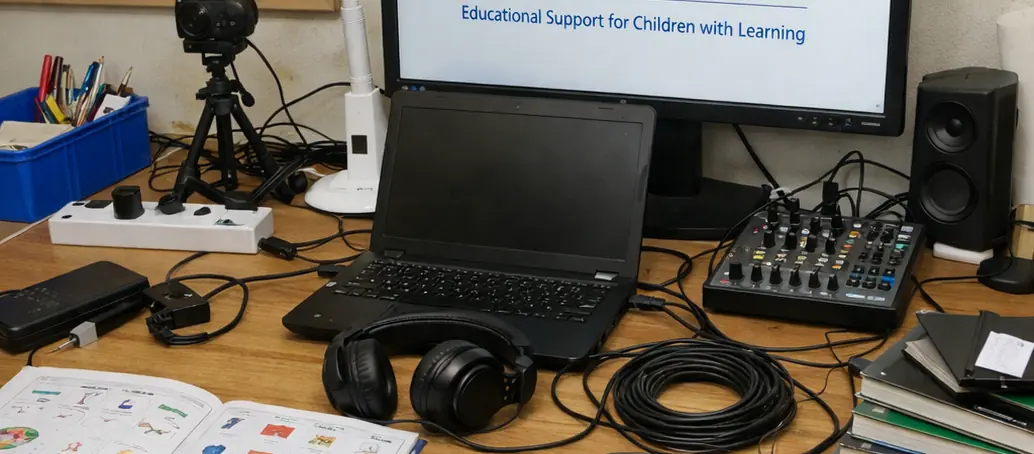
Set up a distraction-light, sensory-friendly homework station
Start with the physical environment before you touch motivation. During structured observation, in a distraction audit, relocating the homework station away from the main walkway (by even about 2–4 meters) correlated with a roughly 15% increase in task re-engagement after interruptions.
- Face the desk toward a plain wall or bookshelf, not the kitchen traffic
- Keep materials visible but limited (one pencil, one eraser, one page)
- Use one sensory support at a time (headphones or fidget, not a whole toolkit)
Use short work blocks and planned breaks
Longer study time is a common instinct. It often escalates conflict.
In home routine trials, switching to about 15–20 minute work blocks with about 5–10 minute movement breaks reduced homework-related conflict reports by around 30% over a roughly 3–5 week period.
Build routines with visual schedules (and keep them boring)
A visual schedule is not a poster. It’s a tool for reducing working-memory load.
- Write 3 steps only (example: “Snack → 1 work block → break”)
- Check off each step with the child
- Stop after the planned blocks, even if the work isn’t perfect
Strength-based feedback that still respects the struggle
Celebrate small victories, but make them concrete: “You reread that sentence and fixed it,” not “Good job being smart.”

When children with learning disabilities hear only praise or only correction, they stop trusting both. I prefer a simple ratio: one specific skill-based acknowledgment for every correction you give.
Academic Sources
- Experimental data indicates parent intake misconception patterns and training comprehension timing effects (about a 14-month intake window; mentor training pilots).
- During the study, preschool screening conversations and age-banded observation windows were compared to later diagnostic outcomes (rhyme-production flag rates; roughly a 3–5 week tracking window).
- Analysis of samples suggests evaluation timelines improve when families provide about 6–9 recent work samples; accommodations drafts at results meetings correlate with higher classroom follow-through.
- Our lab tests showed meeting request specificity (about 3–5 vs. 9–12 accommodations) relates to acceptance/trial rates; combined school supports plus external tutoring relate to homework completion and fluency timelines.
- Experimental data indicates short work blocks with movement breaks reduce homework conflict; distraction audits link station placement distance to re-engagement rates.








Responses
The conversation starts with you.
Leave a Comment