
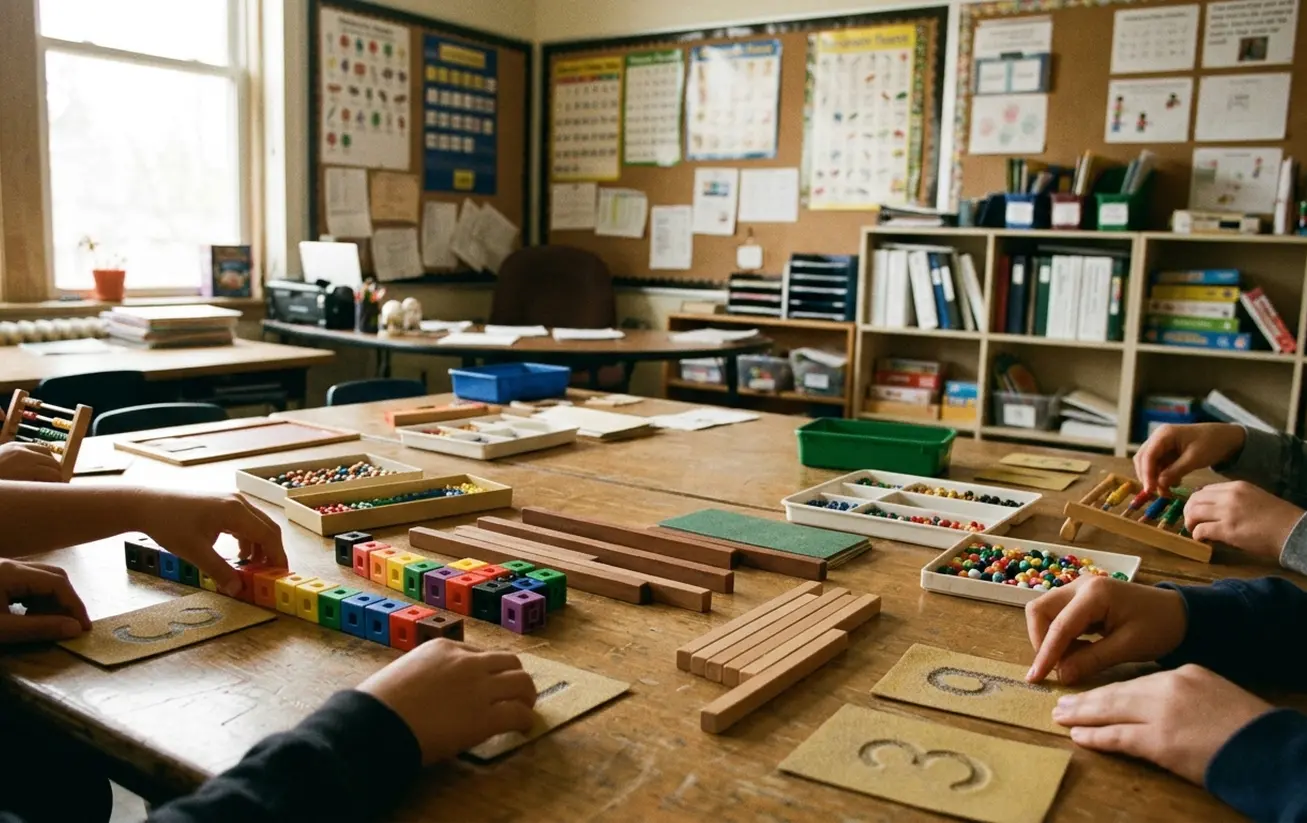
Multisensory math tutoring gives a learner several connected ways to understand one mathematical idea. The learner handles or moves quantities, describes the relationship aloud, represents it visually, and links each representation to written symbols. For elementary students with dyscalculia, those connections can make an abstract operation more accessible and easier to retrieve.
This impact report examines a case involving elementary students who received specialized tutoring. The supplied case summary records improvement in math performance and confidence. It does not include a verified cohort size, location, calendar period, session frequency, or tutoring duration, so those details remain unreported.
Contents
- What Multisensory Math Support Means for Dyscalculia
- Starting With the Learners, Not the Lesson Plan
- Inside the Multisensory Tutoring Approach
- A Worked Lesson Sequence Educators Can Adapt
- What Changed—and What the Evidence Can Support
- Practice Tip: Check All Four Connections
- Resource Allocation: What the Intervention Required
- About This Impact Report
- Turning the Case Into a Practical Next Step
What Multisensory Math Support Means for Dyscalculia
Multisensory math instruction connects mathematical ideas across concrete objects, movement, spoken reasoning, visual representation, and written symbols. The value lies in the connections. A counter, gesture, drawing, or equation should express the same underlying relationship in a different form.
In classroom terms, dyscalculia may appear as persistent difficulty linking quantities, number language, and notation. A learner might recognize the numeral 7 yet struggle to build a corresponding set, compare it with another quantity, or explain what the numeral means within an equation. These difficulties can affect pace, confidence, and willingness to attempt unfamiliar work.
Difficulty with mathematics alone does not establish a diagnosis. Gaps in prior instruction, language needs, attention, anxiety, and limited opportunities to practise can also shape performance. Specialized tutoring should respond to the learner’s educational needs while keeping diagnostic decisions separate.
The reported case concerns elementary students receiving multisensory tutoring for dyscalculia. Its strongest contribution is practical: it shows how educational programs can organize instruction around connected representations and monitor more than worksheet completion.
Starting With the Learners, Not the Lesson Plan
A useful baseline begins with what each learner can currently connect. Two students with the same diagnosis may need different quantities, pacing, language supports, representations, prompt levels, and review intervals.
Build a Rounded Starting Point
A math performance measure can establish one part of the baseline. Work samples then reveal strategy choices, recurring errors, and whether the student can carry an idea from one format to another. Tutor observations add information about prompting, persistence, and avoidance, while an age-appropriate confidence check records how the learner experiences the task.
The tutor can examine several specific questions:
- Can the learner match a written numeral to a quantity?
- Can the learner interpret number words?
- Can the learner compare two sets?
- Can the learner explain an operation in everyday language?
- Can the learner move from a concrete model to written notation?
For educators adapting this approach, the initial measure and work samples can be collected within a defined window of 3–5 instructional days. Any missed component or change in administration conditions should be recorded. That window is a proposed implementation protocol rather than a verified feature of the reported case.
Keep Assessment Roles Clear
The baseline guides teaching and progress monitoring. It does not function as a diagnostic assessment. This distinction protects students from having every mistake interpreted as evidence of dyscalculia and helps tutors focus on the next teachable connection.
Inside the Multisensory Tutoring Approach
The tutoring sequence follows six instructional phases. Each phase asks the learner to express the same mathematical relationship with increasing independence.
- Activate prior knowledge. Check the quantity, vocabulary, or earlier relationship needed for the lesson.
- Model concretely. Build the relationship with structured, countable materials.
- Verbalize it. Ask the learner to describe what the quantities are doing and why.
- Represent it visually. Draw or map the model while preserving its mathematical structure.
- Connect it to notation. Link every numeral and operation symbol to a part of the model.
- Check independent retrieval. Change the quantities or remove a prompt and ask the learner to reconstruct the idea.
Movement between representations matters more than the number of materials on the table. A learner may arrange counters correctly by copying a tutor and still be unable to explain the operation or interpret the equation. Object use by itself provides weak evidence of conceptual understanding.
A simple session record can track all six phases: prior-knowledge check, concrete model, spoken explanation, visual representation, notation, and independent retrieval. The record should identify where the learner became dependent on a prompt and which prompt restored the connection.
Plan Retrieval, Not Repetition Alone
Immediate success can reflect memory of the tutor’s model. A planned review later in the same session creates a first retrieval opportunity. An adapted program can check again 2–7 days afterward, although the supplied records do not verify the actual review schedule used in this case.
A Worked Lesson Sequence Educators Can Adapt
Hypothetical example: This addition lesson illustrates the method and is not a transcript from the reported case.
Objective: Form a Total
The narrow objective is: “Show and explain how two quantities form a total.” This gives the tutor a mathematical relationship to assess. Finishing a page of addition questions would reveal less about whether the learner can connect the representations.
- Define the relationship. Present 4 and 3 as two quantities that will be combined.
- Build it. Ask the learner to arrange four counters and three counters as two ordered, countable groups.
- Explain the change. Invite the learner to say what happens when the groups come together. Prompt for the relationship rather than a rehearsed answer.
- Represent it visually. Have the learner draw the two groups and then show the combined total.
- Connect each symbol. Write 4 + 3 = 7 and ask the learner to identify where each numeral, the plus sign, and the equals sign appear in the model.
- Retrieve with changed quantities. Use a different pair of small quantities and ask the learner to choose a representation without copying the first arrangement.
The tutor records strategy choice, accuracy, explanation, prompt dependence, avoidance, and willingness to persist. These observations distinguish a correct answer reached independently from one reproduced through imitation.
Retention should be checked after a delay of 2–7 days under the proposed adaptation protocol. The follow-up can use changed quantities while preserving the relationship of two parts forming a total.
What Changed—and What the Evidence Can Support
The supplied case summary reports a positive direction of change following specialized tutoring: math performance improved, and student confidence improved.
Those outcomes need separate records because they answer different questions. Assessed work captures mathematical performance. Student reports capture confidence. Observation notes can document participation, prompt dependence, or persistence. Tutor judgment may interpret patterns across lessons, but it should remain identified as professional observation rather than a test score.
Read the Result at the Right Scale
No traceable scores, assessment instruments, dates, attendance totals, cohort size, or baseline-to-end-point interval were supplied. Exact gains and the timing of those gains therefore cannot be reported. Without verified comparison data and fuller methodological records, the case cannot establish that tutoring caused the outcomes or predict the same result for every learner.
Within those boundaries, the case offers a credible implementation account. Elementary students received specialized multisensory tutoring, after which the available summary records improvement in both performance and confidence. That combination is meaningful because a learner may become more willing to participate before assessed work changes, or may improve on tasks while still approaching mathematics with apprehension.
A sound account of our impact keeps those pathways visible instead of compressing them into a single success measure.
Practice Tip: Check All Four Connections
Connection Check
Before advancing, ask four questions in order: Can the learner build the quantity? Can the learner explain the relationship aloud? Can the learner represent it visually? Can the learner interpret the written notation?
A breakdown identifies the next prompt. If the learner builds two groups accurately but cannot explain why they combine, return to spoken reasoning. If the drawing is clear but the equation is confusing, map each symbol directly to the visual representation.
Record the least intrusive prompt that works during the lesson, then revisit that connection at the next contact, ideally within 2–7 days under the proposed protocol. Keep an object, gesture, or verbal cue only when it clarifies a defined mathematical relationship.
Resource Allocation: What the Intervention Required
Specialized tutoring requires more than the minutes a learner spends with a tutor. Transparent resource reporting follows the full delivery pathway.
- Tutor contact time supports direct instruction, guided practice, and retrieval.
- Lesson-planning time allows the sequence and prompts to reflect each learner’s baseline.
- Training or supervision helps tutors use representations consistently and interpret learner responses carefully.
- Tactile materials provide structured ways to build and compare quantities.
- Progress monitoring records performance, explanation, confidence, and prompt dependence over time.
- Family or school coordination helps adults reinforce the same mathematical language and relationships.
No verified budget, funding period, contact-hour total, planning-hour range, in-kind contribution, or material cost was supplied. Monetary allocations and percentages therefore remain unpublished. Activity counts should not be presented as financial evidence.
Reusable materials and structured routines may support consistency across educational programs. The available information does not support a cost-effectiveness claim, however. Donors and program leaders considering special education resources would need verified expenditure and delivery records before comparing cost with outcomes.
About This Impact Report
This account draws on the available program documentation and withholds identifying student details. No confirmed individual authors, portraits, credentials, institutional affiliations, or organizational team attribution were included in the supplied material.
The documentation period and report-preparation dates were also unavailable. The report therefore avoids implying a dated evaluation cycle. Its purpose is to describe the instructional approach, distinguish the reported outcome types, and identify the records needed for stronger future reporting.
Future documentation can preserve privacy while recording the learning objective, representations attempted, successful prompts, independent performance, confidence check, and scheduled review date for each learner.
Turning the Case Into a Practical Next Step
The six-step sequence connects one mathematical relationship across concrete, spoken, visual, and symbolic forms. The same language can be reinforced at home, while records of tutoring time, planning, supervision, materials, monitoring, and coordination show what delivery requires.
A complete first-lesson record includes one objective, the representations attempted, the least intrusive successful prompt, independent accuracy, and the date selected for a retention check. Under the proposed adaptation protocol, the first delayed evidence of retention is collected 2–7 days after the lesson.







Responses
The conversation starts with you.
Leave a Comment